
Front Tooth Restoration Using Bioclear
Overview
Composite Bonding Case Study
This Smile Concepts’ patient had orthodontic treatment with a local dentist to correct her occlusion. Within two weeks of completion of orthodontic treatment she had a bang to her front tooth. This resulted in a dentine fracture of the upper right central incisor. The tooth was subsequently restored using a traditional layered composite restoration.
The following case study describes how the Bioclear Method was used to treat a cosmetically failed traditional composite restoration of an upper central incisor.
When a front tooth is chipped or a previous repair begins to show a “line,” it can affect your confidence in every way.
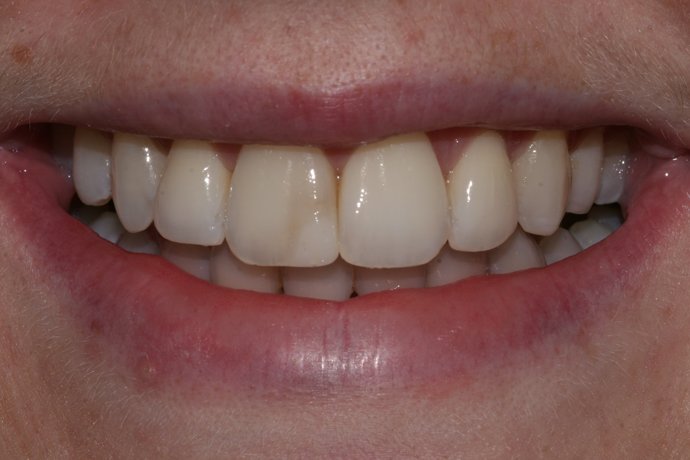
The line between the tooth and composite restoration was becoming noticeable.
The lady attended our practice here in Solihull several months after the restoration with concerns over the appearance of the front tooth. She was conscious that the line between the tooth and composite restoration was becoming noticeable. Friends and family had commented on the visibility of the line.
The fracture line was diagonal, which can be one of the hardest margins to mask clinically when restoring a tooth. The patient elected to proceed with a Bioclear Method composite restoration using the infinity edge margin to mask the fracture line. This isn’t your standard dental bonding; it is an “injection-overmoulding” technique that creates a monolithic, seamless shield over the tooth.
Tooth Restoration Process
Steps
Deep Cleansing
We used the Bioclear Blaster to remove every trace of biofilm, ensuring the strongest possible bond.
Precision Shaping
Using specialized anatomical matrices, we recreated the tooth’s natural “emergence profile”.
Heated Composite
We used medical-grade heaters to warm the material to 70 degrees, allowing it to flow perfectly into every microscopic space for a flawless finish.
Process
Clinically, a single shade was selected to match the tooth shade. The selected shade of composite compules were then heated using the HeatSync heater to 70 degrees.
The front four teeth were isolated using rubber dam. The tooth was disclosed and the Biofilm was removed by basting the tooth with water and Aluminium Trihydroxide using the Bioclear Blaster. This was repeated to ensure all Biofilm was successfully removed.
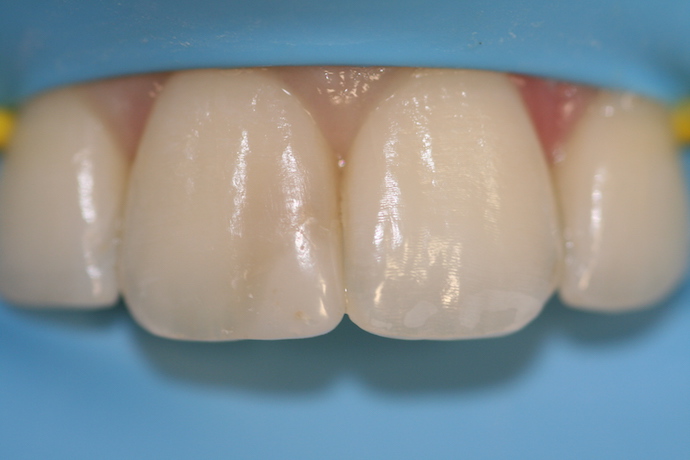
The front four teeth were isolated using rubber dam.
The old composite was then removed and the margin was refined to produce an infinity edge margin.
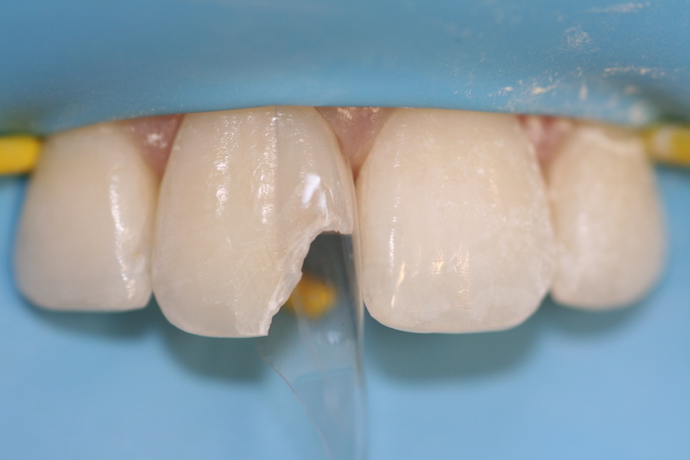
The old composite was removed prior bioclear restoration.
An anatomical Bioclear matrix was selected for the mesial surface of an anterior tooth. The Bioclear matrices are anatomically shaped matrices, which allow you to recreate the correct emergence profile and anatomy of the restored tooth. The process of injection-overmoulding of the composite was then used to restore the tooth. The restoration was shaped using a combination of fine diamond burs and Soflex discs. No interdental finishing or shaping was required as the matrices provided the correct shape and smooth Mylar finish. The restoration was completed using the Bioclear Method 3 step polish. The occlusion was confirmed after removal of the rubber dam.
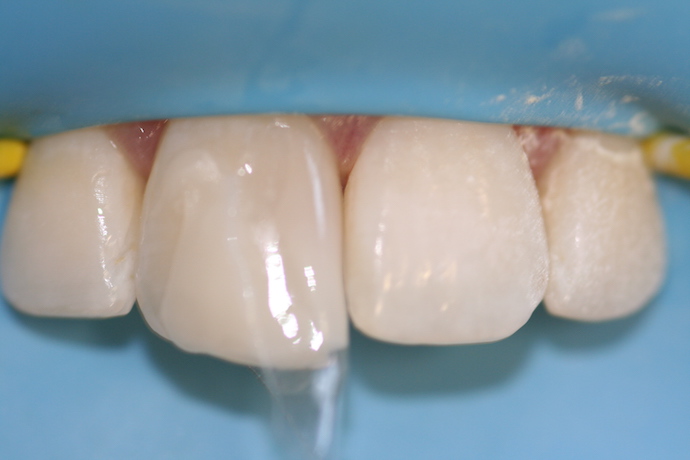
The restoration was completed using the Bioclear Method 3 step polish.
Long-Lasting Results
The patient was very pleased with the result. 6 months later whilst in a gym class she was hit in the mouth with a dumbbell. In many cases this would have shattered a traditional veneer or bonding. However, when she came in for an emergency check-up, there was no damage to the Bioclear restoration.
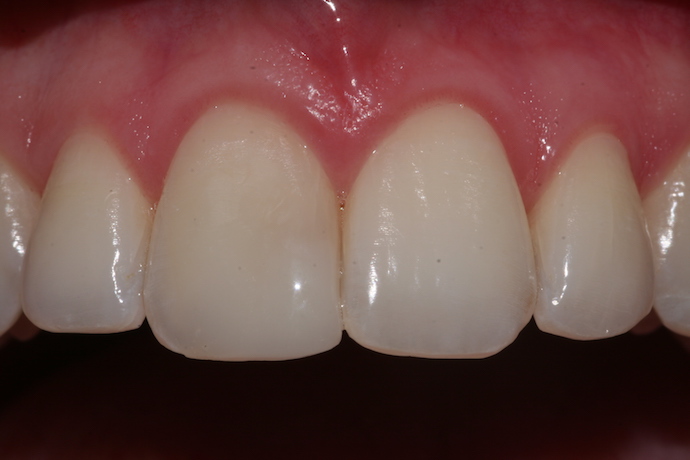
Choose the Bioclear Method for longer lasting, stronger, and aesthetically superior composite restoration results.
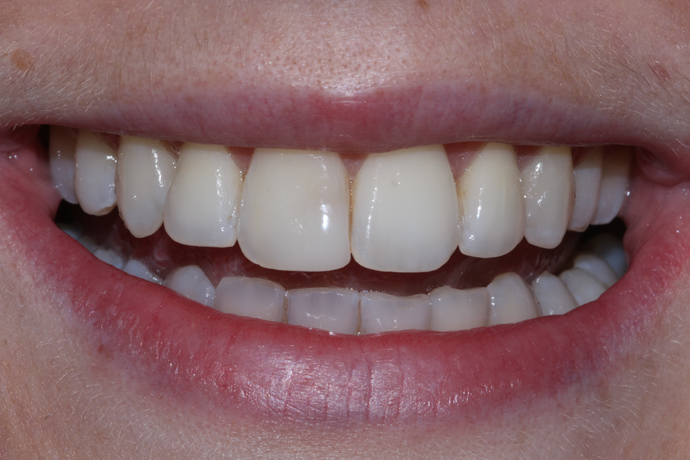
The same patient, two years later.
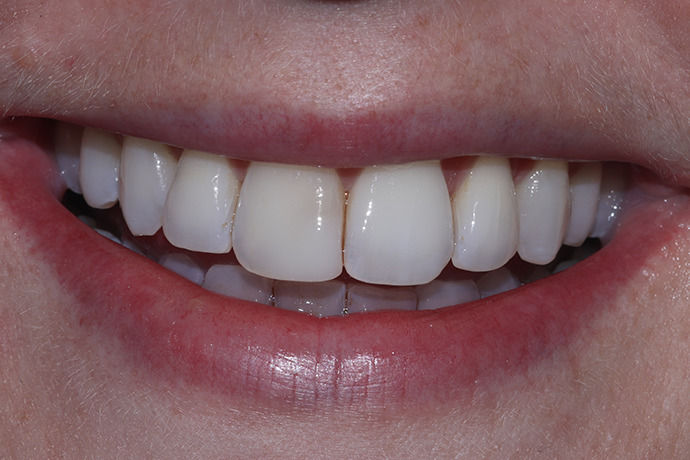
Bioclear front tooth repair seven years later.
The Bioclear matrices are the only anatomical anterior matrices. They enable dentists to successfully treat a variety of clinical situations including standard class III restorations and more complex black triangle and Diastema closures.
The Bioclear matrices form one component of the Bioclear Method, which allows dentists to predictably produce longer lasting, stronger, and aesthetically superior composite restorations.
More About Bioclear
For Patients
- Read the Bioclear Method explained for more information on the Bioclear matrices and this composite restoration.
- Ready to see if Bioclear is right for you? The next step is a tailored consultation, here at Smile Concepts at 91 Lode Lane, Solihull, B91 2HH. We have plenty of parking.
For Dentists
- Are you a dentist with Bioclear equipment and would like further training?
- Learn more about our anterior composite bonding course, bioclear hands-on residential held at Dominic Hassall Training Institute, near Birmingham
- Check out our posterior composite bonding course, bioclear hands-on residential also held at the same postgraduate dentistry school.